Copiapo, Chile (CNN) -- Mining engineers in Chile say they have come up with a "Plan B" that could halve the time it will take to rescue the 33 miners trapped inside a mine since August 5.
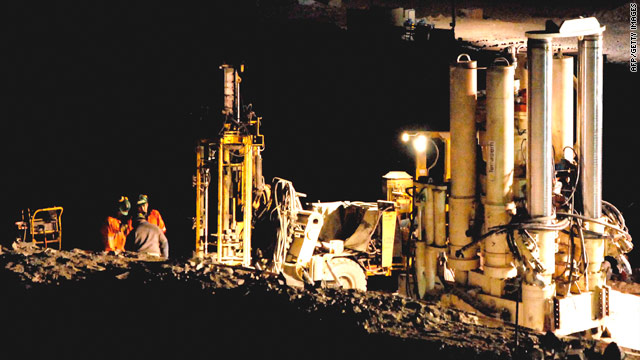
Walter Herrera, quality control and risk manager for Chilean mining company GeoTech, said his company was bringing a specialized device -- a Scram T-130 drill, typically used for boring water holes -- to the San Jose mine. He told CNN Saturday the drill could be on site and working within five to six days.
He said the plan hinges on using one of the three bore holes, measuring four-inches each in diameter, that have already been drilled and are being used to pass the miners supplies. The drill would use that bore hole as a pilot and simply widen the diameter to about 28 inches.
Herrera said the plan his company has drawn up indicates that workers would have to drill 624 meters (2,047 feet) to reach the miners.
"I don't want to put a time frame on this," he said. "We think it could be quicker than the other plan. In ideal conditions, this could take around two months".
The miners have been told they could be stuck underground for as long as four months, the head of the rescue operation said Friday.
Officials expect drilling on a rescue shaft, a process that workers have said could take four months to complete, to begin Sunday or Monday.
Herrera said both operations -- to drill the rescue shaft and widen the bore hole -- could be carried out at the same time.
Still, even under the best-case scenario, the trapped miners will be underground for quite some time -- posing a host of practical and psychological problems. To help solve them, Chilean officials are looking in unlikely places.
An official at NASA, the U.S. space agency, said on Friday the organization has been asked by Chile to help provide nutritional and behavioral health support to the miners. A four-person team, including two physicians and a psychologist, are planning to go to Chile next week, said Michael Duncan, NASA's lead on the Chile effort.
NASA has a long history in dealing with isolated environments and thinks experiences in space and underground are not too different, he said. CNN
