By REUTERS
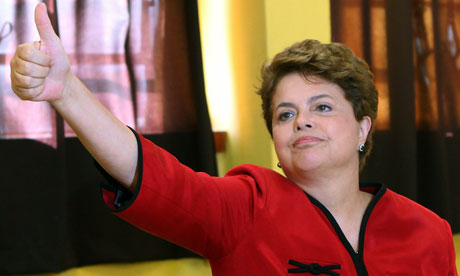
SAO PAULO (Reuters) - Former guerrilla leader Dilma Rousseff won Brazil's presidential election on Sunday after promising to stick to policies that have lifted millions from poverty and made Brazil one of the world's hottest economies.
Brazil's election authorities officially called the vote in Rousseff's favor after she amassed 55.7 percent of valid votes compared to 44.3 percent for opposition candidate Jose Serra, with 95 percent of votes tallied.
The result completed an unlikely journey for Rousseff that took her from jail and brutal torture by her military captors in the 1970s to become the first woman to lead Latin America's largest economy.
An economist and former energy minister who leans left but has become more pragmatic over time, Rousseff had never run for elected office. Yet she received decisive support from Brazil's wildly popular President Luiz Inacio Lula da Silva, who plucked her from relative obscurity to succeed him.
"I think she will continue Lula's work," said Elizabete Gomes da Silva, a factory worker in Sao Paulo. "He governed for the people who needed him most -- the poorest".
During Lula's eight years in office, his stable fiscal policies and social programs helped lift 20 million Brazilians, or more than 10 percent of the population, out of poverty.
The burgeoning middle class is snapping up cars and building houses at a pace never seen in Brazil before, helping make it a rare bright spot in the global economy along with other developing giants such as China and India.
That legacy was simply too much for Serra to overcome.
Serra mustered just enough support in the first round of voting on October 3 to force a runoff, and briefly closed in on Rousseff in subsequent polls. But she pulled away in the final two weeks as the focus shifted away from her views on social issues such as abortion and back to Lula's economic record.
Rousseff is Lula's former chief of staff and vows to build on his successes by upgrading Brazil's woeful roads, schools and other infrastructure as the country prepares to host the 2014 World Cup and 2016 Olympic Games.
She also seeks to exploit Brazil's newfound offshore oil wealth and expand the state's role in the energy sector while continuing to court private investment.
"Her government will focus primarily on solving Brazil's bottlenecks," Fernando Pimentel, a close adviser to her campaign, said in a recent interview.
Rousseff lacks Lula's charisma, and she has shown limited interest in passing major economic reforms, such as an overhaul of Brazil's onerous tax code, that many investors say are necessary to reduce the high cost of doing business.
Some investors also fear she could expand the state's role too much in some areas while failing to rein in heavy budget spending, which has pressured Brazil's real and helped make it the world's most overvalued currency by some measures.
Still, Brazil's stock market, bonds and currency all posted gains in the run-up to the vote -- a stark contrast to the financial panic that preceded the 2002 election of Lula, a former radical.
FROM JAIL TO PRESIDENTIAL CONFIDANT
Rousseff's road to the presidency of the world's eighth-biggest economy was hardly traditional.
The daughter of a well-to-do Bulgarian immigrant, Rousseff joined a leftist guerrilla group during the 1960s and resisted the military dictatorship of that era. She was then jailed for three years and repeatedly tortured with electric shocks.
Upon her release from prison in 1973, she moderated her views and studied economics. She ascended through a range of mid-level government posts in southern Brazil and never showed much political ambition until Lula made her his energy minister, his chief of staff, and then his chosen successor.
Lula has acknowledged Rousseff lacks political experience but chose her because of her skill as a technocrat and administrator. He says those qualities will be critical over the next four years as Brazil tries to bring its infrastructure in line with its ambitions as an emerging world power.
Lula, 65, was barred by the constitution from running for a third consecutive term, but the election of a close lieutenant without a long-standing base of her own may also allow him to remain involved in policy after he steps down on January 1.
On the eve of the election, Rousseff herself said: "Lula will always be present in my government".
Rousseff survived a bout of moderate cancer last year. More recently, she overcame a last-minute corruption scandal that forced a former top aide to resign.
OPPOSITION WILL TRY TO REGROUP
In coming days, Rousseff will be under scrutiny to see whether she makes difficult economic reforms a priority, and whether she fills top cabinet posts with members of the market-friendly wing of her Workers' Party.
The winner of Brazil's presidential election often holds a news conference the day after the vote.
Rousseff's ruling coalition will enjoy a wide majority in Congress that, in theory, should even give her the 60 percent of votes necessary to pass constitutional amendments.
In practice, though, the fractious nature of Brazilian politics -- there are 10 parties in her coalition -- will challenge Rousseff's relatively unproven skills as a dealmaker. She will also face an emboldened opposition PSDB party, which despite Serra's apparent defeat is already vowing to be tougher on her than they were on Lula.
"We cannot let the executive (branch) impose everything, as if this were a monarchy," said Aecio Neves, a senator-elect from Minas Gerais and the likely new leader of the opposition.
Still, the focus for now is on Rousseff and how she plans to continue Brazil's recent run of prosperity.
"The country has never been as good as it is now," said Milton Carneiro, an engineer who voted for Rousseff at a school in Brasilia. "I hope things will continue this way".
(Additional reporting by Eduardo Simoes and Peter Murphy; Editing by Todd Benson and Kieran Murray)
The New York Times