With the second instalment of his TimeRiders adventure series for teenagers in the offing, Alex Scarrow is about to lead us on a dark rollercoaster ride through history
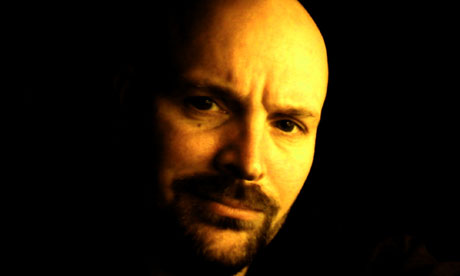
If Puffin's marketing department had tried to invent the ideal author profile to appeal to the difficult early-teenage-boy demographic, they couldn't have improved on Alex Scarrow. A former rock musician, graphic artist and computer game designer, who grew up in the Bahamas and looks like a cross between a surfer dude and a Zen monk? With a fantastically piratical name? That should do the trick.
Fortunately for Puffin, not only does Scarrow exist, he can also write a ripping yarn. Following the success of the first book in his time-travelling TimeRiders series, the publisher has now invested in the full nine-book suite - Puffin's biggest ever investment in a teenage series in a single acquisition. It's a commitment which Scarrow says he's "thrilled to bits" about. "This is going to be a three- or four-year rollercoaster ride," he says. "I'm already buckled in, loose change tucked away and good to go".
"Rollercoaster ride" is also a pretty accurate analogy for Scarrow's stories - and his style. The books feature a crack team of "time-riders", all recruited by a mysterious old man who holds out his hand to them just as they're on the brink of death. There's Liam from 1912, saved as the Titanic fills with water; Maddy, who was about to die on a plane in 2010; and Sal, rescued from a fire in 2029. Along with the old man, Foster, and an artificial intelligence support unit called Bob, their role in the secret organisation is to police time: preserving history as we know it and smoothing over the ripples in time's surface created by illegal time travel.
To add an extra frisson, the TimeRider agency is based in New York City in a time bubble of 48 hours – September 10 and 11, 2001. Over and over, the teenagers are forced to relive the hours before and after the twin towers collapse. Scarrow acknowledges that 9/11 is a "very mature theme" and that there will be younger readers with whom the events of that day will not resonate, but he also believes that "even young readers sense the sobriety, and understand that something bad happened and that the wounds are still raw".
For the older end of the crossover audience for whom he's aiming, of course, 9/11 has a far greater resonance. "It's a nexus point in history," Scarrow says. "A lot of things changed at that moment in time. As I could place the TimeRiders field office anywhere within our adult memory, I thought 9/11 would be the perfect place".
In terms of plot, it also fits because, Scarrow argues, the events of 9/11 provide the perfect distraction for a group attempting to stay under the radar. Despite the niggling echo of Labour aide Jo Moore's infamous remark that 9/11 was "a good day to bury bad news", it's an interesting conceit, and one that Scarrow expands on over the course of the series. In the second book, the team are transported to San Francisco in 1906 in the knowledge that any disturbance their presence causes will be obliterated by the Californian earthquake. As Foster explains in the first book: "your existence here will never affect time, never contaminate time … you'll never be remembered by anyone. All anyone will ever recall of today and tomorrow will be the horrendous images of the planes striking the towers, the towers coming down, the dust-clogged streets, the grief-stricken survivors emerging from the smoke".
The Guardian
