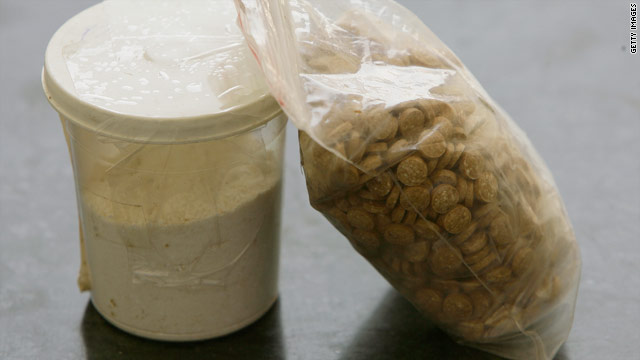
London, England (CNN) -- The Middle East leads the world in amphetamine seizures but governments in the region have been slow to admit there is a drug abuse problem, hindering efforts to fight it.
All intoxicants, including alcohol, are forbidden by Islam, yet "immense volumes" of illegal amphetamines are are being seized in the Middle East, particularly Saudi Arabia, according to Matthew Nice, a drugs expert with the U.N. Office on Drugs and Crime (UNODC).
The World Drug Report 2010, published by the UNODC, shows Saudi authorities confiscated 12.8 metric tons of amphetamine in 2008. A total of 24.3 metric tons of amphetamine were seized worldwide that year, with 15.3 metric tons seized in the wider Middle East.
"I can't emphasize enough the size of this," said Nice, whose specialist area is amphetamine-type-stimulants. "Fifteen metric tons is absolutely huge, it's absolutely phenomenal.
"We're really struggling because the information base is so limited. It's definitely just the tip of the iceberg," he told CNN.
Experts working in the region say abuse of all kinds of drugs is a growing problem.
Professor Jallal Toufiq, founder of the Middle East and North Africa Harm Reduction Association told CNN: "There is a worsening of the drug situation in the whole region, with no exceptions.
"We have to be very careful about this because there are no trend studies, but if you collect indirect indicators, I can tell you with certainty there's an increase in drug abuse in the region.
"We can show it in terms of treatment demand, social expression, related crime, HIV and Hepatitis C increasing in these countries -- all these kinds of indirect indicators".
But he added that a lack of research and data collection on the ground make it hard to identify the scale of the problem.
CNN
