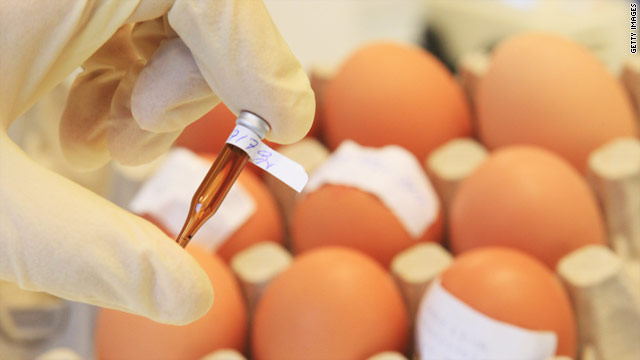
London (CNN) -- Egg products that reached the United Kingdom from farms with tainted eggs likely had dioxin levels well below European Union limits, a spokesman for the European Commission told CNN Tuesday.
Tests conducted on frozen liquid eggs in the Netherlands, which came from the same batch as ones that were exported to the United Kingdom, showed dioxin levels of .23 picograms per gram of fat, spokesman Frederic Vincent said. The allowable ceiling for the European Union in 3 picograms per gram of fat.
The egg scandal stemmed from the discovery of tainted eggs in Germany, which were exported to other countries.
Last week, Germany filed criminal charges against the company at the heart of the country's tainted egg scandal.
The company, Harles and Jentzsch, apparently knew for months that fatty acid it was delivering to animal-feed makers was contaminated with dioxin, said Christian Seifert, a spokesman for the agricultural ministry in the German state of Schleswig-Holstein.
Criminal charges have been filed against the company, Seifert said, "because they did not immediately inform" the agricultural ministry that dioxin levels surpassed the allowed amount.
Authorities allege that the company sold about 3,000 tons of contaminated fatty acids to dozens of companies making animal feed across Germany. In response, the government quarantined more than 4,700 pig and poultry farms.
As for the frozen liquid eggs that made it to the United Kingdom, Vincent said that while there was some contamination, there was never a health risk from any products manufactured with these liquid eggs.
Vincent also said there was no restriction on the movement of German poultry, pork or eggs in the European Union.
Meanwhile, after lifting the quarantine on about 3,000 farms on Monday, the German state of Lower Saxony on Tuesday lifted the quarantine on hundreds more, leaving around 300 farms quarantined in this state, the Ministry for Agriculture and Consumer Protection said in a news release.
Dioxins are a family of toxic chemicals that share a similar chemical structure and have been characterized by the U.S. Environmental Protection Agency as likely human carcinogens. CNN
