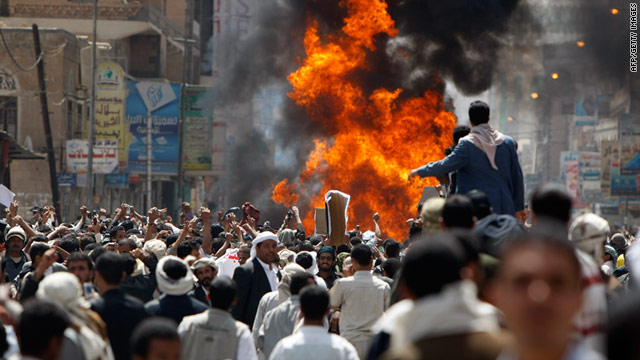
Sanaa, Yemen (CNN) -- Undeterred by the attack on their sit-in a day earlier, anti-government protesters gathered at Sanaa University again on Wednesday to demand that President Ali Abdullah Saleh step down.
"We are worried that it could happen again. But we have nothing to lose and it's for the sake of the country," said Yasser Hasani, a student.
At least two people were killed when government loyalists attacked and opened fire on sit-in participants Tuesday night, an opposition lawmaker said.
Foad Dahaba, a lawmaker with the opposition Islah party, provided the figure to CNN on Wednesday. Until now, protesters had provided conflicting numbers for the toll.
Some of the protesters carried photos of the two victims, calling them martyrs.
"We feel sad for what happened yesterday but we are enthusiastic that their blood will not be forgotten," Hasani said Wednesday. "Everyday that passes with bloodshed makes us stronger and more firm in our demands.
Earlier Tuesday, sit-in participants had overturned a car and set it on fire after discovering weapons inside apparently brought to a demonstration by government loyalists, a protester said.
Demonstrators noticed a parked car near the sit-in and were told that the people in the car were government loyalists who had come to harass them, according to one of the protesters, Adnan al-Nathari.
Several hundred students converged on the car to confront those inside, who then fled, he said. The protesters searched the car and found a rifle and a gun, al-Nathari told CNN. The students then flipped the car and set it ablaze.
There were no injuries reported in that incident.
The sit-in at Sanaa University was one of at least five protests on Tuesday in Yemen. There were others in Aden and Taiz, and in the provinces of Ibb and Lahj.
On Monday, Yemeni President Ali Abdullah Saleh rejected demands that he step aside, comparing the anti-government protests to an illness sweeping through the region.
"This is a virus and is not part of our heritage or the culture of the Yemeni people," he told reporters. "It's a virus that came from Tunisia to Egypt. And to some regions, the scent of the fever is like influenza. As soon as you sit with someone who is infected, you'll be infected".
Saleh added that those seeking change should accept the reforms he has proposed. He had earlier said he won't seek another term in 2013 after being in power for 32 years. He also said he would postpone parliamentary elections scheduled for April to allow more time for discussions about reform. CNN
