Limiting of water, food and power to Bangkok protest area raises fears of violence as negotiations with government fall apart
Associated Press in Bangkok
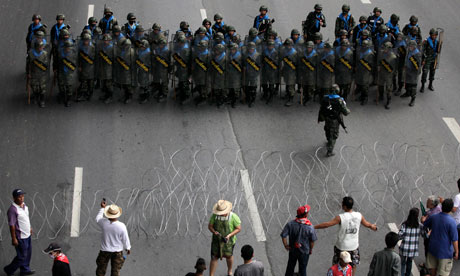
The Thai government turned to siege tactics today over the standoff with protesters barricaded in central Bangkok, announcing that the army would limit supplies of water, food and electricity to the protest zone.
An army spokesman said security forces would "not use force at this stage".
"This is a full-scale measure to limit the freedom of protesters and to close down the area 100%, starting at midnight," said Colonel Sansern Kaewkamnerd.
But the wording of the announcement raised fears of more violence inThailand's two-month political standoff if the red shirt protesters refuse to disperse.
The new measures were announced a day after the Thai prime minister, Abhisit Vejjajiva, warned protesters who have paralysed Bangkok's central business district to leave by the end of today.
The anti-government protests have forced the closure of luxury hotels and damaged the economy, particularly in the tourism sector.
"Electricity and water supply, as well as food, will be limited," Sansern said, warning local residents that they should consider alternate accommodations.
Chances of a negotiated settlement to the standoff appeared to be unravelling. A government spokesman, Panitan Wattanayagorn, said late yesterday that the prime minister had rescinded his compromise offer to hold early elections on 14 November as part of a reconciliation deal.
"He said there will no longer be any more compromises or conditions," Panitan said. "Their refusal to stop the protest meant that the conditions that were set are being cancelled, including the election date".
The protesters vowed to hold their ground, with one of their leaders, Weng Tojirakarn, saying: "The prime minister must not threaten us and must not disperse us. If he wants more deaths, so be it. I don't".
Since the red shirt protest started 12 March 29 people have died and more than 1,400 and wounded in several violent incidents, according to the health ministry.
The Guardian
